A car should fit the driver, not force the driver to work around it. If you are asking, “what modifications can a disabled driver have on their vehicle?”, the practical answer is: far more than many people realise. From hand controls and steering aids to wheelchair access and adapted seating, the right changes can make driving safer, more comfortable and more independent.
The best adaptation depends on how a condition affects strength, movement, sensation, vision or reaction time. There is no single ‘disabled driver’ set-up, and a modification that helps one person may be unsuitable for another. A professional assessment is the safest place to start.
What modifications can a disabled driver have on their vehicle?
Vehicle adaptations generally fall into four areas: controls, access, seating and stowage. They can be fitted to many cars, although some vehicles are easier and more cost-effective to adapt than others. Automatic cars are often a popular choice because they remove the need to operate a clutch, but automatic transmission is only one part of the picture.
Hand controls for braking and acceleration
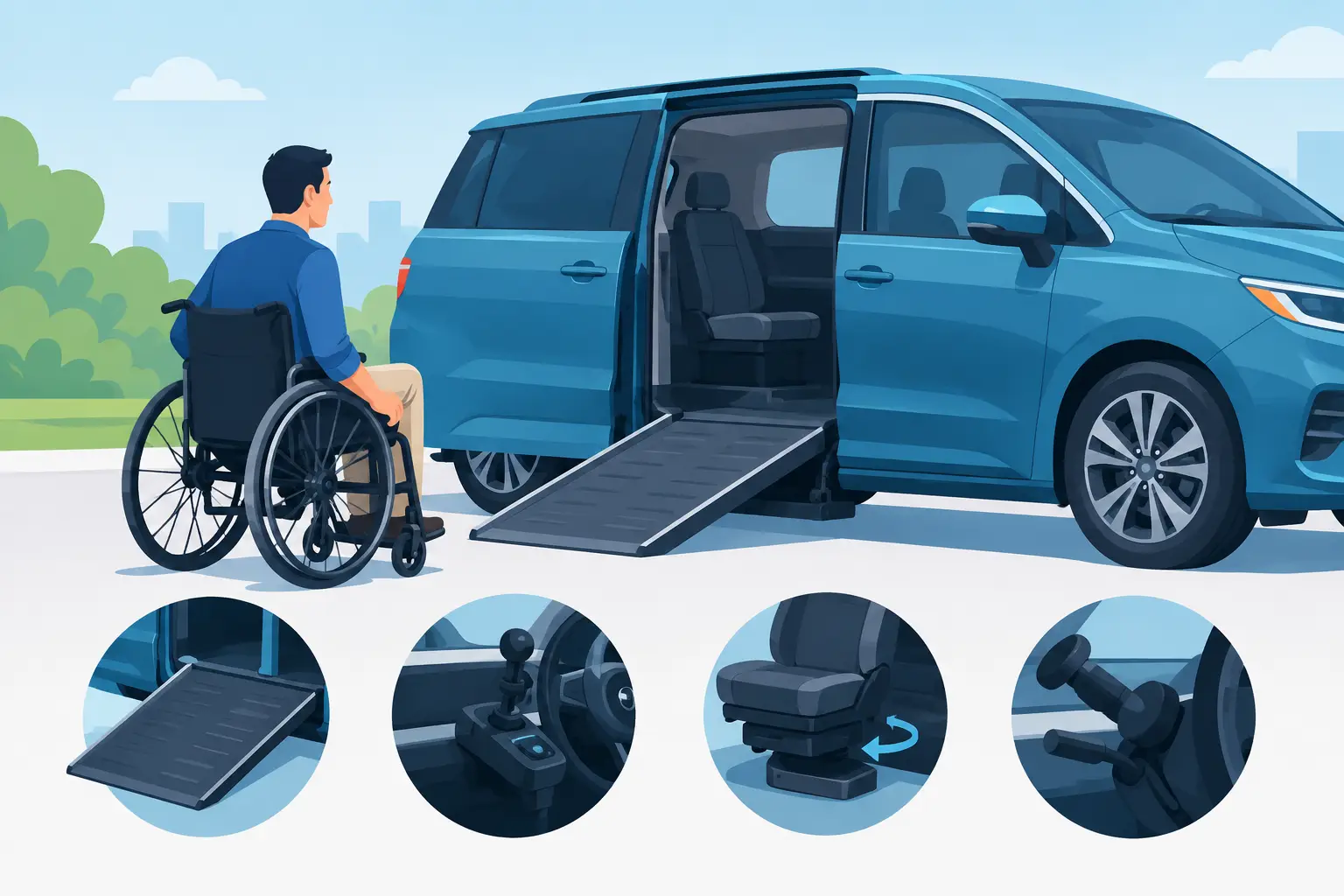
Hand controls allow a driver to operate the accelerator and brake without using their feet. A common set-up uses a lever positioned close to the steering wheel: pushing may apply the brake and pulling may operate the accelerator. Other systems use electronic triggers, radial controls or push-pull devices.
The right choice comes down to hand strength, grip, range of movement and whether the driver needs to keep one or both hands on the wheel. Controls must be positioned so they can be used quickly without obstructing the steering wheel, indicators or other essential switches.
A left-foot accelerator can be another useful option for someone who cannot safely use their right foot. It is normally fitted with a guard over the original pedal to prevent accidental use. This is a specialist alteration, not a simple DIY adjustment.
Steering aids and secondary controls
Drivers with limited grip, reduced arm movement or the use of one hand may benefit from steering adaptations. A steering ball, sometimes called a spinner knob, enables the wheel to be turned with one hand. More advanced electronic steering systems can reduce the physical effort required.
Secondary controls can also be moved or adapted. These may include indicators, windscreen wipers, headlights, horn, hazard warning lights and gear selection. For some drivers, buttons are grouped into a small control unit near the steering wheel. For others, voice activation or electronic controls may be more suitable.
These changes sound small, but they matter during real driving. A driver needs to signal, steer, check mirrors and respond to hazards without losing control or taking their attention away from the road.
Adapted seating and transfer aids
Getting into the car and settling into a safe driving position can be the biggest barrier for some drivers. Swivel seats turn towards the door to make transfers easier, while transfer plates provide a stable surface between a wheelchair and the seat. Electrically adjustable seats can help the driver find a comfortable, supported position.
Seatbelts can be altered with extensions, guides or specially designed fittings where appropriate. Pedal extensions and adjustable steering columns may also help a shorter driver maintain safe reach and posture.
Comfort is not a luxury in this context. Poor seating position can affect steering accuracy, braking response and the ability to look properly at mirrors and blind spots. Any adaptation should leave the driver securely positioned and able to reach every control without stretching.
Wheelchair access and storage solutions
A wheelchair-accessible vehicle may include a ramp or lift, lowered floor, modified door opening or a system that allows a wheelchair user to travel as a passenger while remaining in their chair. Some vehicles can be adapted so the wheelchair is stored in the boot, on a roof-mounted hoist or via a boot-loading device.
If the driver transfers into a standard car seat, a wheelchair hoist can reduce the lifting required. The trade-off is that hoists and ramps add weight, take up space and may affect which vehicle model is practical. It is worth considering everyday journeys, shopping, passengers and parking as well as the driving controls themselves.
Start with an assessment, not a vehicle accessory
Before buying a car or arranging modifications, book an assessment with a qualified mobility or driving adaptation specialist. They can look at your mobility, vehicle entry, driving position and control needs, then recommend equipment that has been properly matched to you.
This step can prevent an expensive mistake. For example, a person may assume they need hand controls when an automatic car with a left-foot accelerator is more appropriate. Someone else may find that a standard automatic is not enough because they also need adapted indicators and a steering aid.
An assessment should consider the future as well as the present. If a condition fluctuates or is progressive, ask whether the adaptation can be adjusted, transferred to another vehicle or upgraded later.
Licence, DVLA and insurance considerations
You must tell the DVLA about a medical condition or disability if it could affect your ability to drive safely. The DVLA may ask for medical information, arrange further enquiries or issue a licence for a shorter period. In some cases, your licence may show a restriction requiring certain adaptations or automatic transmission.
If you learn and take your practical test in an automatic vehicle, your licence will normally be restricted to automatics. If you take the test using specific adaptations, the licence may carry codes that reflect what you need to drive safely. This is not a setback. It ensures your licence accurately supports safe, independent driving.
You should also tell your insurer about any vehicle adaptations before they are fitted or as soon as they are installed. Insurers need an accurate record of the vehicle, and some may ask for details of the equipment or installer. Do not assume an adaptation is covered simply because it improves access or safety.
Learning to drive with adaptations
Learning with adaptations often requires a more personalised approach. The driving skills are still built around observation, planning, control and safe decision-making, but the method of operating the car may be different. Early lessons should allow time to practise the controls in a quiet area before progressing to busier roads.
A learner using hand controls, for example, needs to develop a reliable routine for steering, braking, acceleration and signalling. An instructor should help make that routine calm and repeatable, rather than rushing towards complex junctions before the basic controls feel natural.
It is also sensible to check that the instructor and car are suitable for your needs before booking. Explain the adaptation you use, whether you are learning in your own vehicle and any support that helps you get in and out of the car. A supportive conversation upfront leads to safer, more productive lessons.
For learners in North London, CJL Driving School can discuss whether automatic tuition and a structured lesson plan are suitable for your route towards independent driving. Where specialist adapted tuition is needed, it is better to establish this early so the right vehicle and instructor arrangements can be made.
Choosing a vehicle: practical questions to ask
A vehicle may be technically adaptable but still not work well for daily life. Think about the width of your driveway, how much room you have to open doors, whether you need to carry mobility equipment and how easy the car is to park. Smaller cars can be easier to manoeuvre, while larger vehicles may provide the access and boot space needed for a wheelchair or hoist.
Ask whether the modification affects the vehicle’s resale value, warranty, servicing or MOT requirements. Use reputable fitters who can provide documentation for the work completed. Keep that paperwork with the vehicle records, particularly if equipment is electronic or connected to safety-critical controls.
Can a disabled driver drive a manual car?
Yes, some disabled drivers can and do drive manual cars. Pedal extensions, adapted clutches and other solutions may help in particular circumstances. However, an automatic often reduces workload and gives the driver more capacity to focus on the road. The right answer depends on the individual assessment, not on whether manual or automatic is seen as the ‘better’ option.
Are adaptations only for permanent disabilities?
No. Adaptations can also support people recovering from an injury, surgery or a temporary change in mobility. The key question is whether you can operate the vehicle safely and consistently. Speak to a medical professional and check any DVLA reporting duties before returning to driving.
Do vehicle modifications make driving less safe?
Properly assessed, professionally fitted adaptations are designed to improve safety by allowing the driver to operate the car with confidence and control. Problems arise when equipment is poorly matched, incorrectly fitted or used without enough practice.
The aim is not simply to make a journey possible. It is to create a driving position and control system that lets you respond safely, comfortably and confidently every time you get behind the wheel.
Driving Lessons for Disabled Drivers at Numero Uno Driving School
At Numero Uno Driving School, they believe everyone should have the freedom of driving. That’s why they offer lessons for provisional licence holders with a range of physical disabilities, taught in our specially adapted Toyota C-HR.
The C-HR is easy to get in and out of thanks to its raised height and long doors. A Car Cane is available to help further, and they happy to put your wheelchair in the boot if needed.
Their car is fitted with:
- Jeff Gosling hand controls with indicator switch
- Jeff Gosling left-foot accelerator
- Jeff Gosling steering wheel ball
- Lodgesons Lollypop 13 switch
- Panoramic mirrors
Familiarisation Tuition
Already have your licence but using an adapted vehicle for the first time? Their familiarisation lessons help you get comfortable safely, with an instructor who can take control from the passenger side using dual controls. Motability recommends around 6 hours to adjust to hand controls and 10 hours for a left-foot accelerator.
Funding Support
You may be eligible for funding through Motability. Call them on 0300 456 4566 to check, and remember to note the name of the person you speak to and your CRN number.
Contact them today through their website to book your first lesson.



Leave A Comment