54B, Tailstoi Town 5238 MT,
La city, IA 522364

Drive Safe & Smart with Us
Every pain avoided but in certain circumstances and owing to the claims of duty or the obligations of business it will frequently occur that pleasures have to be repudiated and annoyances accepted selection he rejects pleasures to secure.

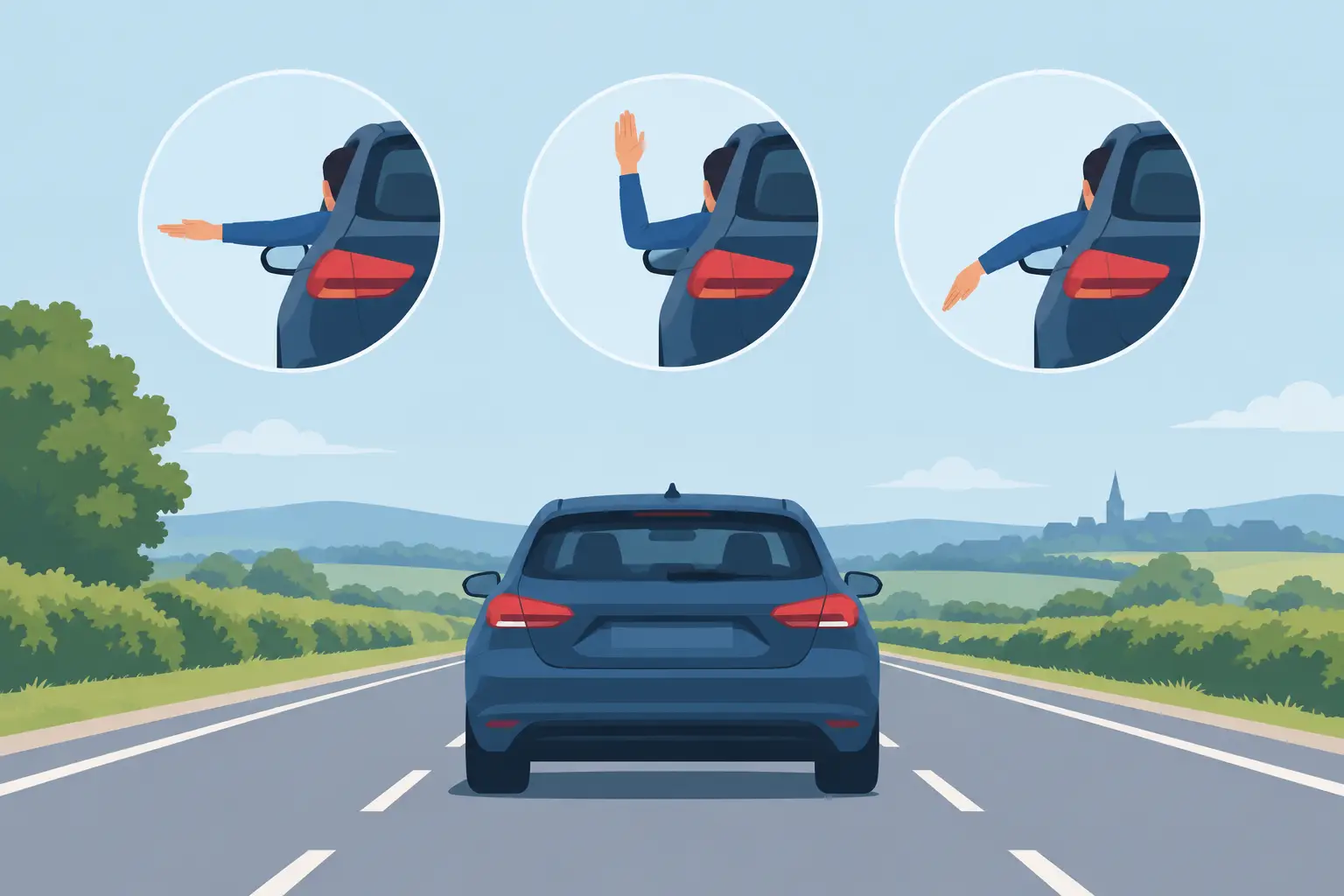
A failed indicator at a busy North London junction can turn a routine drive into a moment that demands calm, clear communication. Learners often ask, “what are arm signals when driving in the UK, and how should they be used?” They are the recognised hand and arm signals used to tell other road users that you intend to turn, move out, slow down or stop – particularly when your indicators are not working.
They may feel old-fashioned in a car fitted with modern lights and dashboard warnings, but arm signals remain part of the Highway Code knowledge every driver should understand. More importantly, they reinforce a bigger driving skill: making your intentions clear without assuming other people can read your mind.
What are arm signals when driving in the UK?
In the UK, drivers give arm signals from the driver’s side of the vehicle. Because the driver sits on the right, the right arm is used for all three standard signals. They are designed to be clear enough for drivers, riders and pedestrians behind or alongside you to recognise.
The three signals tell others that you intend to turn or move right, turn or move left, or slow down and stop. They are not a substitute for observation, position, speed and good judgement. A signal communicates your intention; it does not give you priority or make a manoeuvre safe.
Turning right or moving out to the right
To show that you intend to turn right or move out to the right, extend your right arm straight out at shoulder height. Keep it steady and visible for long enough for people behind to understand what you are planning.
This might be relevant if your indicator has failed and you need to turn right at a crossroads, pull out to overtake a parked vehicle, or move into a right-hand lane. Before acting, check your mirrors, assess the road ahead and make the appropriate blind-spot check. The arm signal comes after your decision to manoeuvre, not before it.
Turning left or moving in to the left
To signal that you intend to turn left or move in to the left, hold your right arm out and bend it upwards at the elbow so that your forearm is vertical. Use an open hand and keep the signal clear.
This is the signal that catches many learners out because it can feel less intuitive than a left indicator. Remember that you are signalling from the right-hand side of a right-hand-drive vehicle. It is especially useful if you need to pull in after passing an obstruction or turn left with faulty indicators.
Slowing down or stopping
To show that you intend to slow down or stop, extend your right arm and move it up and down in a controlled, obvious movement. Do not wave vaguely or make a small gesture that could be missed.
Use this signal early enough to give the person behind time to respond. If traffic is close behind you, brake progressively rather than sharply where possible. Your brake lights should normally provide this warning, but an arm signal is a valuable extra safeguard if your rear lights have failed or visibility is poor.
When should you use arm signals?
The clearest answer is: use them when your normal direction indicators or brake lights cannot communicate your intentions properly. This could be because of an electrical fault, a bulb failure or damage following a minor collision. If you notice a fault while driving, do not panic. Keep the journey only as long as necessary to reach a safe place or arrange repairs, and make every action deliberate and well planned.
Arm signals can also be useful as an additional warning in unusual situations, such as very slow-moving traffic or when you are driving an older vehicle. However, they should not become a routine replacement for indicators in a modern car. Indicators are more visible at night, in rain and in heavy traffic, while both hands are needed for full steering control.
That trade-off matters. Taking one hand off the wheel for an arm signal slightly reduces your control, particularly on a bend, uneven road or when manoeuvring at speed. Use the signal only when it adds useful information, and return both hands to the steering wheel before carrying out the manoeuvre.
How should arm signals be used safely?
Give the signal in good time, but not so early that it could be misunderstood. For example, signalling left well before two side roads may lead someone to assume you are turning into the first one. Your road position and speed should support the message your signal gives.
Use the same thinking that applies to indicators: mirrors, signal, position, speed and look. Check your mirrors first so you understand what is around you. Signal clearly, position the car correctly and adjust your speed. Then look again before you turn, move out or pull in. A cyclist, motorcyclist or pedestrian may have moved into a space you thought was clear.
Avoid relying on an arm signal where it cannot be easily seen. Darkness, heavy rain, glare from headlights and a dirty rear window can all reduce visibility. If it is dark and your lights are faulty, the safest option is usually to stop somewhere safe and seek assistance rather than trying to continue using hand signals alone.
It is also worth remembering that a signal is an indication, not an instruction to others. A driver behind may fail to see it. A motorcyclist may be filtering. A pedestrian may step into the road. Always wait until the space is genuinely safe before completing the manoeuvre.
Arm signals on your driving test
You should know the three arm signals for your theory test and for safe everyday driving. Your examiner may ask you a “show me, tell me” question related to vehicle safety, but you would not normally be expected to use arm signals during a practical test in a vehicle with working indicators.
Never switch off or ignore your indicators just to demonstrate that you know the signals. On test day, use the car’s controls correctly and drive in the safest, most normal way. If a vehicle fault develops, tell the examiner straight away and follow their instructions.
For learners, the real value of practising the signals is confidence. Understanding them helps you respond calmly if an indicator warning light appears, and it helps you recognise what another driver may be telling you. At CJL Driving School, we teach communication as part of the full driving picture: observation, anticipation, control and courteous decision-making.
Common mistakes to avoid
A frequent mistake is signalling while still travelling too fast for the turn or manoeuvre. An arm out of the window does not make a late approach safer. Slow down first where needed, then keep your signal clear and your steering controlled.
Another is giving a signal without checking mirrors and blind spots. You may be telling people what you want to do, but you still need to know whether someone is already alongside you. This is particularly important around cyclists and motorcyclists, who can be harder to spot in busy urban traffic.
Finally, do not hold an arm signal for longer than necessary. Once you have made your intention clear and are ready to steer, bring your hand back to the wheel. Good driving is calm and purposeful, not dramatic.
Knowing the three signals is a small piece of driving knowledge, but it can make a real difference when normal lights cannot do the job. Learn them, practise them safely when stationary, and let clear communication support every confident decision you make on the road.

Leave A Comment