54B, Tailstoi Town 5238 MT,
La city, IA 522364

Drive Safe & Smart with Us
Every pain avoided but in certain circumstances and owing to the claims of duty or the obligations of business it will frequently occur that pleasures have to be repudiated and annoyances accepted selection he rejects pleasures to secure.

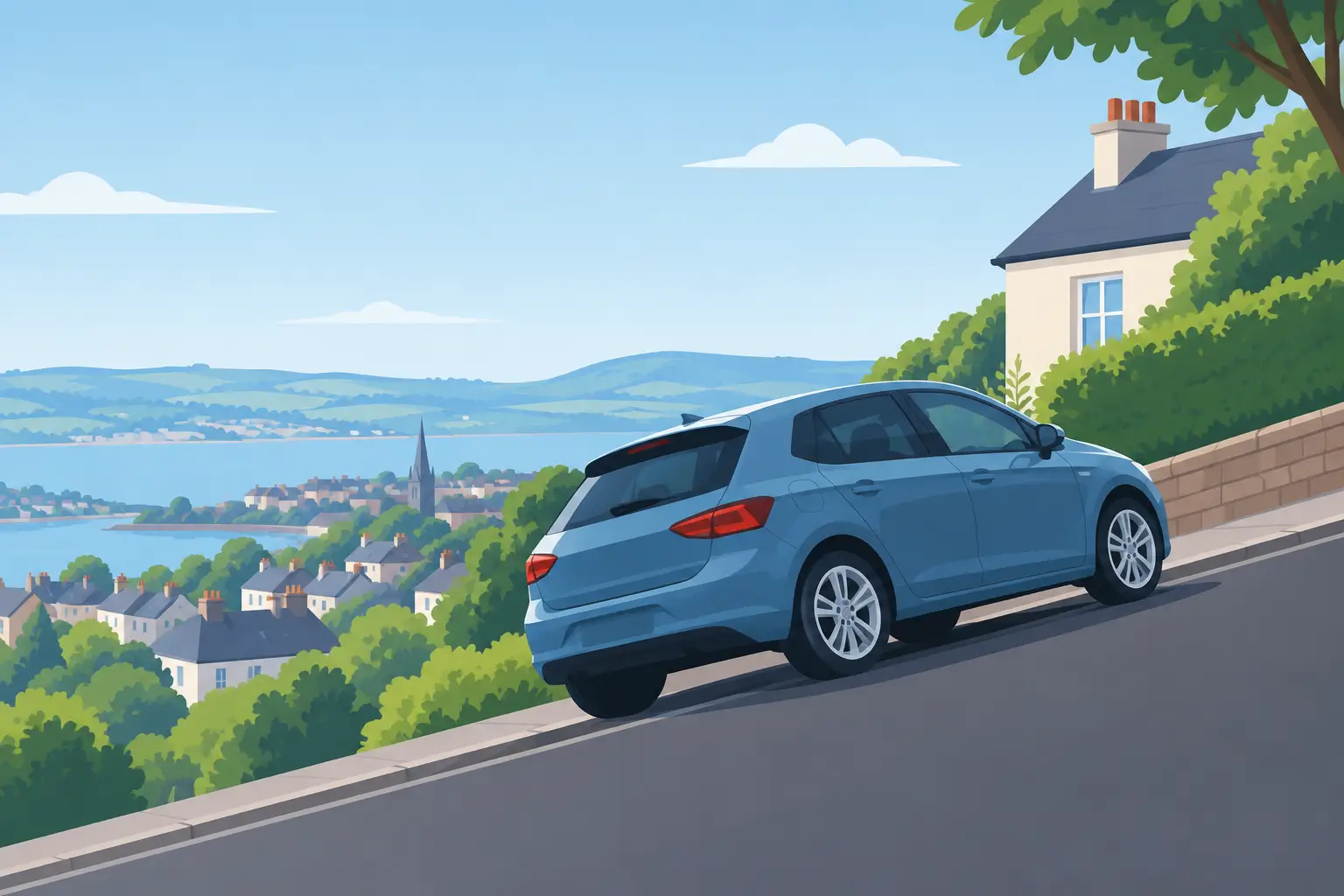
A steep residential road can make a simple parking manoeuvre feel much more serious. Your car is heavier than it feels from the driver’s seat, and if it rolls even slightly, it can quickly become a risk to pedestrians, cyclists and other vehicles. These tips for parking on hills in the UK will help you secure the car properly, understand your steering position and show the safe routines an examiner expects.
Start with a safe place to stop
Before thinking about gears or the steering wheel, make sure you are allowed to park there. A hill does not change the normal parking rules. Check for yellow lines, controlled parking signs, bus stops, dropped kerbs, junctions and driveways. Do not stop where your vehicle would restrict the view for people emerging from a side road, especially on narrow North London streets where parked cars already make visibility difficult.
Give yourself enough space from the vehicle in front and behind. Parking too tightly on a slope makes it harder to pull away smoothly and increases the chance of a small roll into another car. If the hill is particularly steep, the road is icy, or there is loose gravel or wet leaves under the tyres, consider finding a flatter and safer space if one is available.
As you approach the space, use your mirrors, signal if necessary, and check your blind spot before moving in. A hill does not remove the need for good all-round observation. In fact, pedestrians may be walking close to the kerb because the pavement is narrow or uneven, so take your time.
Tips for parking on hills in the UK: secure the car first
Once you are in position, keep firm control of the car with the footbrake. Apply the parking brake fully before you release the footbrake. This order matters: it prevents the car rolling while you are securing it.
In a manual car, select a gear after applying the parking brake. First gear is generally suitable when facing uphill, while reverse is generally suitable when facing downhill. The selected gear gives the engine compression a chance to resist movement if the parking brake were to fail. It is an added safeguard, not a replacement for applying the parking brake properly.
In an automatic, apply the parking brake and select Park. Avoid relying on Park alone, particularly on a steep slope. The parking brake should still be used because it helps reduce strain on the transmission’s parking mechanism and provides an extra layer of security.
Before leaving the vehicle, take a moment to check that it is genuinely stationary. Ease the footbrake carefully only when the parking brake is fully applied. If the car moves, apply the footbrake again, secure the parking brake more firmly and reassess your position. Never try to hold a parked car on a hill using the clutch biting point.
Turn the wheels to reduce the risk of a roll-away
Your wheel direction is one of the most useful safety measures when parking on a gradient. The aim is simple: if the vehicle did begin to roll, the front wheels should guide it towards the kerb rather than out into the road.
Facing downhill with a kerb
Turn the steering wheel towards the kerb. The front wheels should be angled so that a forward roll would bring the tyre into contact with the kerb. Do not park with the tyre hard against it, as this can damage the tyre or wheel, but position the car sensibly close to the kerb where it is safe to do so.
Facing uphill with a kerb
Turn the steering wheel away from the kerb. If the vehicle rolls backwards, the front of the car will move towards the kerb rather than swing out into traffic. This can feel counter-intuitive at first, which is why it is worth practising until it becomes automatic.
Facing uphill without a kerb
Turn the wheels towards the edge of the road, where a roll-back is less likely to carry the vehicle into the path of traffic. However, use judgement. A deep ditch, soft verge, cycle lane, pedestrian area or another hazard may mean that location is unsuitable for parking altogether.
The exact angle of the road, the kerb shape and the available space can affect how the vehicle sits. The key principle remains the same: secure the car and make an uncontrolled movement less dangerous.
Do not forget the Highway Code and night-time rules
When parking at night, be aware of how your vehicle is facing. The Highway Code advises that vehicles must not be parked facing against the direction of traffic flow at night, except in recognised parking spaces. This helps other road users see your vehicle’s rear reflectors and reduces confusion on unlit roads.
You should also avoid parking close to the brow of a hill. Drivers approaching from either side may have very limited sight of your vehicle until the last moment. Even if there are no road markings prohibiting it, it may still be an unsafe choice. A few extra metres to a clearer section of road can make a significant difference.
If you are parking on a hill in the dark, check that your lights are switched off before you leave the car, unless parking lights are required or appropriate. Leaving lights on can flatten the battery and may create unnecessary glare for other road users.
Pulling away again: prepare before releasing the brake
A correctly parked car still needs a controlled start when you return. Settle into the driver’s seat, adjust if needed, fasten your seatbelt and prepare the car before you release the parking brake. Check the mirrors and blind spot, particularly downhill, where cyclists may approach quickly and be hidden by the angle of the road.
In a manual car facing uphill, select first gear, find the biting point, add enough gas for the gradient and keep the footbrake applied until the car is ready to move. Release the parking brake only when you feel the car wants to pull forward. A small amount of roll-back can happen while learning, but your goal is to prevent it through calm preparation rather than rushing.
When facing downhill, control speed with the footbrake and use the appropriate gear for the gradient. Avoid coasting in neutral. You need the engine’s control as well as the brakes, especially on a long or steep descent.
Automatic drivers should use the footbrake to hold the vehicle while selecting Drive or Reverse, then release the parking brake only when they are ready to move. Some cars have hill-hold assistance, but treat it as support rather than something to depend on. The system may work differently between vehicles or disengage after a short time.
Common mistakes learners can avoid
The most common error is concentrating so hard on the hill that observations are forgotten. Your routine should still include mirrors, signalling where needed and blind-spot checks. Another mistake is applying the parking brake but forgetting to select a gear in a manual car, or selecting Park in an automatic without applying the parking brake.
Learners also sometimes turn the wheel in the right direction, then straighten it before getting out because the angle looks unusual. Leave the wheels positioned for safety until you are ready to drive away. Finally, do not rush to leave the car. Check that doors are locked and that you have not left valuables on display.
Practising on a quiet, suitable gradient with an instructor is the best way to build confidence. At CJL Driving School, hill starts and safe parking routines can be broken into clear stages, so you understand not just what to do, but why each action protects you and others.
The next time you park on a hill, pause for those extra few seconds. A fully applied parking brake, the right gear or Park selected, and wheels turned with purpose are small actions that show safe, smart driving.

Leave A Comment