54B, Tailstoi Town 5238 MT,
La city, IA 522364

Drive Safe & Smart with Us
Every pain avoided but in certain circumstances and owing to the claims of duty or the obligations of business it will frequently occur that pleasures have to be repudiated and annoyances accepted selection he rejects pleasures to secure.

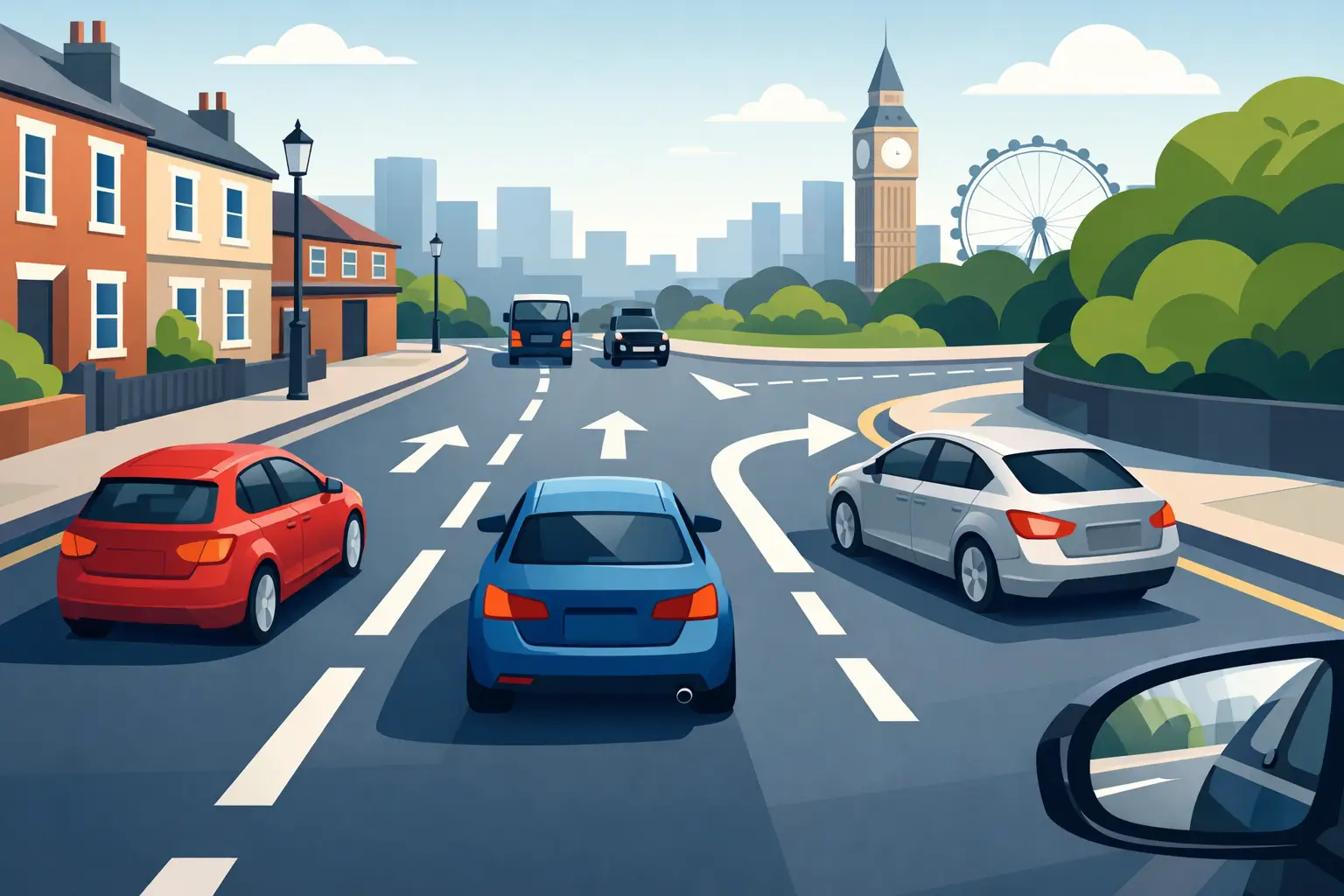
A one-way street can look simple: every vehicle is travelling in the same direction. Yet it is a common place for learner drivers to lose good road position, miss a lane arrow or feel pressured by traffic behind them. Understanding one-way streets and how to position your vehicle on UK roads is not about squeezing through gaps or copying the car in front. It is about reading the road early, choosing the correct lane and keeping enough space to make safe decisions.
One-way systems are particularly common around busy town centres, shopping areas and test-route hotspots. They often combine parked vehicles, pedestrians, buses, cyclists and several lanes heading towards different exits. A calm, planned approach will help you drive safely and show the examiner that you can deal with changing road layouts independently.
Start with the signs, markings and road layout
The first clue is usually the one-way sign: a blue rectangular sign with a white arrow pointing in the permitted direction of travel. You may also see arrows painted on the road, lane-control signs, give-way lines and direction signs before the junction. Do not wait until you reach the turning to decide where you need to be.
As soon as you recognise a one-way street, ask yourself three questions: where am I going, which lane serves that route, and what road users could be beside me? This simple thought process gives you time to check mirrors, signal when needed and move into position without rushing.
Road markings take priority when they allocate lanes. On a wide one-way road, the left lane does not always mean left turn only, and the right lane does not always mean right turn only. Follow the arrows and signs for your chosen exit. If the markings are unclear or you are unsure, continue in the lane you are safely in rather than making a late lane change.
One-way streets and how to position your vehicle
Your position should make your intended direction clear while leaving safe space from hazards. Although traffic moves only one way, that does not mean every part of the road is available for you to use.
Going ahead
If you are going straight ahead, use the lane marked for ahead traffic. On a narrow one-way street with no lane markings, drive in a sensible normal position – usually slightly left of the centre of the usable carriageway. Avoid hugging parked cars, as an opening door or pedestrian stepping out can create an immediate hazard.
On a wider road, resist drifting across lanes simply because there is no oncoming traffic. Keep to your lane and use your mirrors regularly. Cars, motorcycles and cyclists may be overtaking, filtering or preparing to turn at the next junction.
Turning left
For a left turn, position your vehicle towards the left-hand side when it is safe and appropriate to do so. Check your centre and left mirrors early, signal in good time, then make a final left-side observation before turning. A cyclist may be travelling alongside you, particularly where there is a cycle lane or a gap between your vehicle and the kerb.
Do not move into a bus lane, mandatory cycle lane or marked bay unless the signs confirm you may use it. The correct position is not simply as far left as possible – it is the correct lane, with safe clearance from the kerb and other road users.
Turning right
When turning right from a one-way street, position close to the right-hand side of the carriageway unless signs or lane markings direct you elsewhere. This is different from turning right on a normal two-way road, where you would usually approach near the centre line.
Check the centre and right mirrors before signalling and moving over. Look well ahead for road arrows, traffic islands, pedestrian crossings and vehicles that may be in a right-turn lane. Keep your steering controlled through the turn and enter the correct lane on the new road. If you are turning into a two-way road, you will normally turn into the lane nearest to the centre line, unless markings tell you otherwise.
Choosing a lane at a multi-lane junction
Many one-way systems lead to large roundabouts, crossroads or traffic-light junctions. The lane choice must be made before the junction, not halfway through it. Read the signs from a distance, use the road markings as confirmation and take the lane that matches your destination.
For example, a left lane may be marked for left only, the middle lane for ahead, and the right lane for right turns. In that situation, using the middle lane to turn right because it looks quicker is unsafe and may cause another driver to brake or take evasive action. If you miss your lane, go where the lane takes you and allow your satnav to reroute later.
Look out for contraflow cyclists and buses
One-way streets are not always one-way for everyone. Some roads allow cyclists to travel in the opposite direction through a signed contraflow lane, and others permit buses, taxis or authorised vehicles to use dedicated sections. These arrangements are clearly signed, but they can surprise drivers who assume there will be nothing coming towards them.
Before moving left, turning across a cycle lane or pulling away from the kerb, check carefully for cyclists. At junctions, look into the road you are entering as well as the road you are leaving. A cyclist travelling contraflow may appear from a direction you do not expect.
Give parked vehicles a sensible gap and avoid using a painted cycle lane as extra driving space. The same applies to yellow box junctions, hatched areas and bus lanes: markings are there to manage traffic and protect road users, not to provide a shortcut.
Avoid the mistakes that create pressure
The most frequent errors on one-way streets tend to happen when a learner focuses only on the destination. They spot a right turn too late, steer across from the left lane, or position too close to parked cars while trying to make up time. A driving test is not a test of whether you can recover every missed turning. It is a test of whether your decisions are safe and legal.
Keep your speed appropriate for what you can see. One-way streets often have restricted views because of vans, delivery vehicles, shopfronts and parked cars. Travelling too quickly reduces the time available to read an arrow, react to a pedestrian or give a cyclist room.
Be especially careful at the end of a one-way street. You may need to give way, stop at lights or choose between several lanes. Check for pedestrians crossing near the junction, even if there is no formal crossing. When moving off after stopping, use the routine your instructor has taught you and do not assume the space beside you is clear.
A simple routine for driving one-way systems
Use a steady routine: plan, position, observe and proceed. Planning means looking well ahead for signs and lane arrows. Positioning means moving into the correct lane early and smoothly. Observation means checking mirrors, blind spots where necessary, pedestrians and cyclists. Proceeding means making the turn with control, without sudden braking or late steering.
This routine is useful in both manual and automatic cars. In a manual vehicle, select a suitable gear before the junction so you can focus on steering and observation. In an automatic, avoid relying on the car to manage every decision – you still need to control your speed and select the right position early.
During lessons, it is worth practising the same one-way system more than once. The first drive helps you recognise the layout; the next lets you improve your planning and lane discipline. CJL Driving School instructors can build this work into lessons around North London’s busier road layouts, helping you turn uncertainty into a repeatable skill.
The best position on a one-way street is rarely the most aggressive one. It is the position that follows the signs, communicates your intention and gives you room to respond. Stay observant, accept that an occasional missed turn is better than a rushed manoeuvre, and each one-way system will become another chance to drive safe and smart.

Leave A Comment